
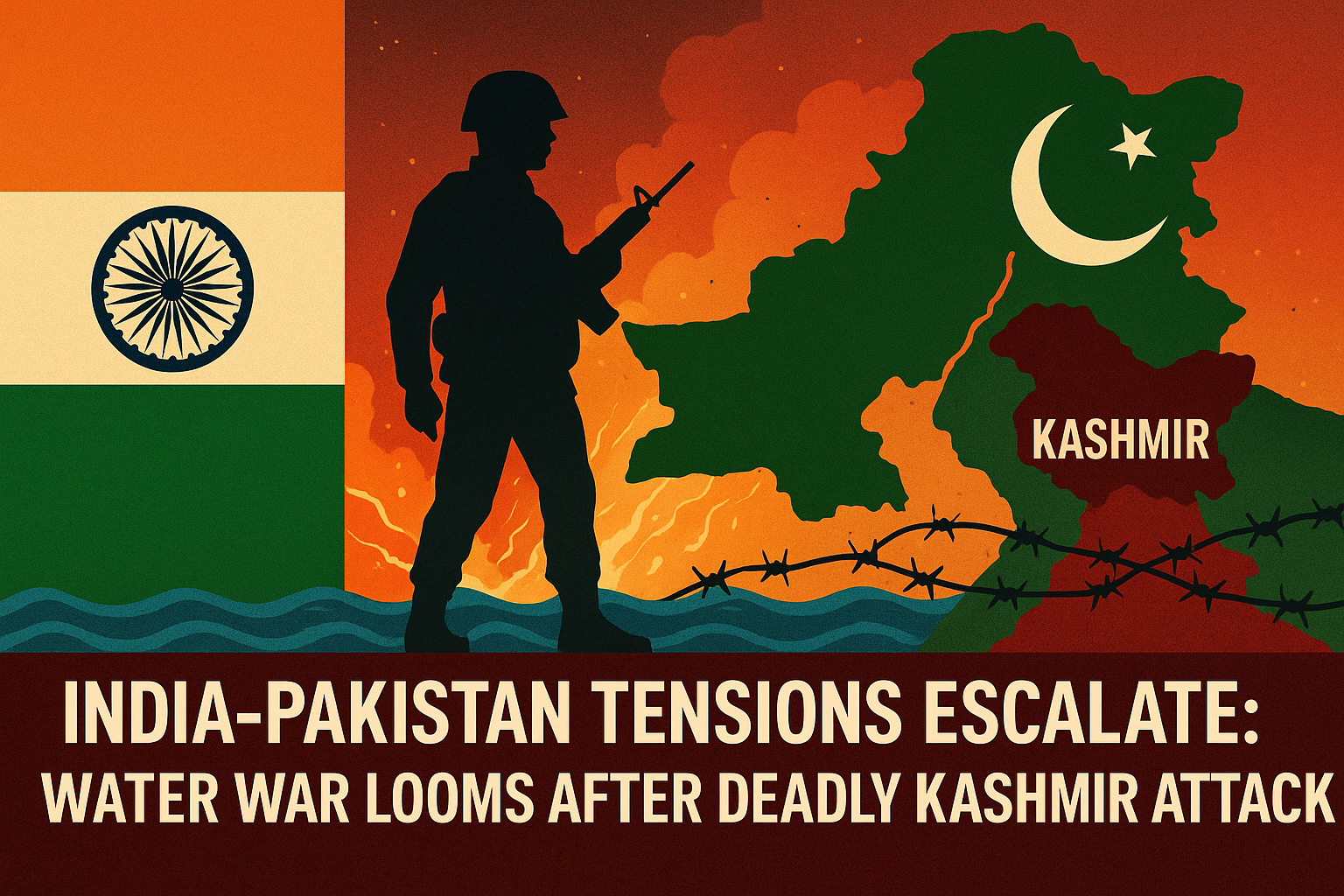
The India-Pakistan relationship has once again plunged into deep turmoil following a deadly terrorist attack in Jammu and Kashmir on April 22, 2025. The attack claimed the lives of 26 Indian nationals and was attributed to Pakistan-based militant groups, further straining relations between the two nuclear-armed neighbors.
In response to the attack, India has suspended the Indus Waters Treaty (IWT), a key agreement that has governed the distribution of water from the Indus River system between the two countries for over 60 years. This suspension threatens to exacerbate the ongoing geopolitical and economic crisis in South Asia, particularly regarding the critical issue of shared water resources.
This article delves into the current India-Pakistan situation, the implications of suspending the Indus Waters Treaty, and the geopolitical and economic risks associated with this move.
Deadly Kashmir Attack: Triggering a New Crisis
On April 22, 2025, a terrorist attack near Pahalgam, Jammu and Kashmir, led to the tragic deaths of 26 Indian tourists. The attack, claimed by The Resistance Front (TRF), a Pakistan-based militant group, targeted civilians in a popular tourist area, causing outrage in India. The attack was seen as a clear provocation from Pakistan and further fueled tensions along the Line of Control (LoC).
In response, India launched retaliatory airstrikes on militant camps in Pakistan-administered Kashmir. This exchange of fire resulted in casualties on both sides, intensifying the military standoff between the two countries.
The Indus Waters Treaty: A Historical Overview
The Indus Waters Treaty, signed in 1960 under the mediation of the World Bank, allocates the waters of the six rivers of the Indus River system. Under the treaty:
- India controls the Beas, Ravi, and Sutlej rivers.
- Pakistan controls the Indus, Jhelum, and Chenab rivers.
This agreement has been a crucial framework for water distribution, as the Indus River system is vital for agriculture and livelihoods in both countries. However, political tensions have frequently put this treaty to the test.
India’s Decision to Suspend the Indus Waters Treaty
On April 24, 2025, India made the drastic decision to suspend the Indus Waters Treaty. Indian officials justified this move by citing Pakistan’s continued support for terrorism in Kashmir. India argued that Pakistan’s actions have undermined the spirit of cooperation embodied in the treaty.
Indian External Affairs Minister S. Jaishankar emphasized that Pakistan’s failure to curb cross-border terrorism left India with no choice but to act on this crucial water agreement. The suspension raises critical concerns about water security and stability in South Asia.
Pakistan’s Response: The Threat of a Water Crisis
Pakistan condemned India’s suspension of the Indus Waters Treaty, describing it as an “unprovoked and aggressive” act. Pakistani officials have warned that such a move could spark a severe water crisis, especially in the provinces of Sindh and Balochistan, which depend heavily on the Indus River for agriculture and drinking water.
Prime Minister Imran Khan called for international mediation and requested the World Bank and United Nations to intervene, fearing that India’s actions would escalate into an even greater regional conflict.
Geopolitical and Economic Consequences of the Indus Water Dispute
1. Regional Stability and Conflict
The suspension of the Indus Waters Treaty could destabilize the already fragile South Asian region. A water crisis in Pakistan could exacerbate internal unrest and further fuel militancy and insurgency within the country.
2. Diplomatic and Economic Fallout
India’s suspension of the treaty has drawn sharp criticism from the international community. The United Nations and the World Bank have called for both nations to resolve the dispute through peaceful dialogue. Failure to do so could damage bilateral trade, deter foreign investment, and strain regional partnerships.
3. Agricultural Impact
The agricultural sectors of both India and Pakistan are heavily reliant on the Indus River system. India’s Punjab and Pakistan’s Sindh and Balochistan provinces depend on these waters to sustain their farming industries. A potential halt in water flow would likely disrupt food production, leading to food security issues and inflation.
How Water Politics Are Shaping India-Pakistan Relations
The Indus River has long been a point of contention, with both nations accusing each other of violations. Pakistan has raised concerns over India’s construction of dams on the rivers allocated to Pakistan, while India argues that Pakistan is not adhering to the treaty’s provisions.
As tensions continue to rise over Kashmir, both military clashes and water disputes are seen as part of the broader geopolitical rivalry. These tensions underscore the significance of water as a strategic asset in South Asia.
The Future of the Indus Waters Treaty
The Indus Waters Treaty is currently at a critical juncture. If India and Pakistan fail to resolve their differences, the treaty could become another casualty of the Kashmir conflict. The international community has expressed concern about the potential for a water war in the region, with both countries vying for control over the Indus River system.
It is now up to global institutions and diplomatic efforts to mediate between the two nuclear-armed nations and prevent further escalation of this high-stakes water conflict.
Key Takeaways
- The India-Pakistan conflict over Kashmir has now extended to the vital Indus River system, as India suspends the Indus Waters Treaty in retaliation for Pakistan’s support of terrorism.
- Both countries face a water crisis, with agriculture, livelihoods, and regional stability at risk.
- Diplomatic mediation from the World Bank and United Nations is crucial in averting a full-blown water war.
- The situation highlights the growing importance of water diplomacy in the geopolitics of South Asia.